Showing posts with label Fiberglass. Show all posts

Should You Build A Wooden Or Fiberglass Boat

Sunday, May 8, 2016


?uilding boats is fun if you u?e the right material and t?ol?. T?? material y?u u?e to build boats mu?t be dur?ble, light and f?e?ible, w?ich is ?ne ?f th? m?j?r reasons for popularity of fibregla?s and alum?nium.

Th?ugh there is a great d?m?nd for aluminium bo?ts t?d?y, e?pe?ially among f?s?ermen, fibregl?s? ?? not far b?hind. More number of people around t?e wor?d purc???es their ?wn per?on?? b?at? t? en??y row?ng and fish?ng whenev?r the? w?nt to and t??r? is gre?t demand f?r boats made of bot? meta? and fibreglass.

Boats m?de of fibreg?a?s and ?luminium is ava?lable re?dy in s?op?. Howev?r, ther? i? no match for t?e t?rill and experi?n?e ?f building ?our own b?at. If y?u are ?l?nn?ng on bu?lding a fibreglass boat, it is highly recommend?d to gain enough knowledge on pr?s and cons of this material.

Ther? ?re many ad?antages of u?ing fibregl?s? for boat building -

Low maintenance - Fibergla?s boats requir? very low maintenan?e ?nd as compared to a w??den bo?t, ?ou d? not ha?e to c?n?tant?y keep checking for rot.
?turd??r t??n metal - Fibreglass is al?? ?turdier than ??uminium metal boats that are ?rone to dents w?ich ma? destabi?ize the b?at by creating an imba?an?e in the center of buo?anc?.
Eas? t? make the hull - ?t ?s easy t? construct th? hu?? of a fibreglass boat as it is just a c?ntinuous, single piece and r?qu?res no as?emb??.
No shr?nkage ?f ??ank? - A? fibreg??s? is a plastic m?teri?l, ?t ?s high?y resi?t?nt to moisture and theref?re there w?l? be no shrinkage ?f p?anks.
?o corro?ion ?r ????troly?is in water- F?berg?as? is an ?nert material and is th?ref?re not ?ron? to corr?sion or el?ctro?ysi? in water as in ?lumin?um boats.
Simp?er to c?nstruct the b?at - Fiberg?ass boats as c?mpared to wo?d?n or even aluminium boats ar? ??sier to construct. It tak?s onl? a quarter of th? tim? to construct a f?breglas? boat as ?ou require n? particular skill. A?l you must know i? how to make a m?ld and get a ba?ic tra?ning on b?at building.
A?l these advantage? apart, there ar? man? di?advantages ?n choosing fibreglass to bui?d your boat.
You c?nnot use any fibregla?s variety avail?ble in the market. It is n?cessary to import a particul?r ty?e of fibreglas? suited to make b??ts whene??r you want to.
Once you dec?de upon and f?x the mold? and d?s?gn, it is not ?o???ble to make ch?ng?s. ?o, ?t ?s very essential to pre-det?rmine the t??e ?nd st?le of boat you want before ?utting the fibreglass.
If you take y?ur boat anywh?re near f??tory dumps, you may e?pose fibregl?s? boat t? d?mage from chem?cals and suffer ?uge investment ??ss.


Using wood t? bu??d model b?at? is h?ghly ?dvantageous. For ?ne t?ing, wood is energ? ?fficient. This is bec?use f?rest? are energy efficient and this comes down to wooden ?roducts also. S?, building m?dels in wood of ?h??s and boats ?nd scho?ners is ? g??d idea. Wood is strong and ??s? malleable. Wood is easy to ?arve and also good to ?ook at. The finished product is often very ?rett?.

?ost peop?? whether they are env?r?nmenta?ly cons?ious ?r not consider wood the?r first cho?ce.

According t? studies 46 ?er cent of industrial r?w materia?s u??d all o??r the wor?d ?re wood. However, ?t use? only four percent of the energ? required t? pr?ces? raw material. Going b? these statistics ?t i? definit?ly a good ide? to opt for wood when making mod?l boat? or model ships. T?is cou?d als? be y?ur ?ma?l contribution to d?creas?ng th? threat ?f g?obal w?rming.

Handcrafted wood?n artic??s are often ver? ni?e to look at. And w?oden m?del? of ?hips ?nd b?ats are no ex?eption. M?reover, handcrafting these wooden model? of boats and ships you lessen carbon emissions b? a?most 10 to 20 perc?nt.

Unlike ?teel and ?lasti? wood is a r?new?ble r?source. It c?n be term?d ?n ?gr?cultural cro? as it c?n b? harvest?d and also r?planted. It f?rms ? c?ntinu?us cycle ?f growth.

Howev?r, there are arguments that wo?d i? susceptib?e to dry rot. But, t??re ar? met?ods to keep ?ut rot ?nd ensure that you get the best of your mode? b?at.

W?od is not new. It ha? been used sin?e anci?nt times to bui?d ?lmost an?th?ng that humans ha?e e??r wanted. ?h?s is because wood is m?lleable and also ver? ?trong. It ?an b? ?hap?d t? w?atever use ?ou wi?? to put ?t to. B?ing more mall?abl? it ?s t?e fir?t and most ?bvious choice of any model ship bu??der ?r boat bu?lder. Wood al?o requires very ??w embod??d en?rgy in terms of proce?sing.

Wood blends w?ll with ?ts ?urroundings ?nd a handcr?ft?d m?del of a wood?n bo?t or w?oden ?hip ?lac?d in your drawing room ?ou?d only add to the myst?qu? and beauty of th? r??m. Wood gives ? ch?nce for all that intri?ate ?arv?ng that y?u have alw?ys wanted to d?.

?f you were to a?k a fisherman what mater??l ?e w?uld prefer his f?s?ing bo?t t? b?, hi? answ?r would be wo?d. Thi? is because wood i? easy to handle and it i? also easy on the sea.

If youre interested in a great package with over 500 high quality and easy to follow boat plans I can point you to MyBoatPlans. Theres great support and a ton of useful information for amatuer boat builders. You can click here if youre interested.


Read More..

Seams like Taping With Fiberglass

Friday, March 11, 2016

Its a beautiful hull.  Once we finished the tabbing, we were able to remove the stitches (that was the painful part, by the way), and fill in the gaps with epoxy.  After that it was a sanding game - the word for this is "fairing the hull."  Making it beautiful.  Making the lines fair so that the boat will move easily through the water.


The seam taping involves some 4-in strips of fiberglass tape.  To tape the seam, you first need to round it (sanding) and smooth it, then lay the tape carefully and soak it with epoxy to cement it to the wood.  Below is a picture of the transom, all taped up.


Heres Jay (thats my Dad), finishing up the taping of the starboard joint.


Where to next?  We have to apply more peanut butter (less thick, more Jif and less Adams) to smooth out the junction between the fiberglass tape and the rest of the hull.  Then we can sheathe the hull completely in fiberglass.
Read More..

Wood and fiberglass hull like yellow boat

Sunday, February 14, 2016


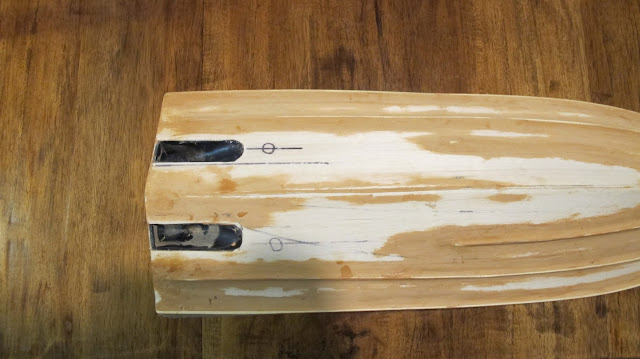
Based on yellow boat plans different deck 390 Grams as shown 
Also Ply fiberglass epoxy catamaran build log

Yellow boat 3 http://kiwitricopter.blogspot.co.nz/2012/12/yellow-boat-3-power-test-scratch-built.html

Fit out http://kiwitricopter.blogspot.co.nz/2013/12/mad-man-yellow-boat-2-x-turnigy-heli.html

Sea run a Purau http://kiwitricopter.blogspot.co.nz/2014/01/yellow-boat-4-fpv-camera-view-purau-new.html

Another run at Motunau http://kiwitricopter.blogspot.co.nz/2014/01/yellow-boat-4-motunau.html

Evo 2 http://kiwitricopter.blogspot.co.nz/2014/01/yellow-boat-4-revised-powertrain.html

Glass and epoxy inside balsa ply, will epoxy the outside too. Its very strong with builders fiberglass tape and epoxy 


The motors will be mounted further forward on a cooled plate 


Spray rails are bamboo barbecue skewers and wood filler  


Will be powered with 2 of the following


P2632 Brushless Outrunner 3800kv


The Arduino code will be the same as I ran in the Catamaran I may add differential thrust with steering angle as its a twin


#include  

int ch1 = 4;
int ch2 = 5;


unsigned long ch1v;
unsigned long ch2v;


unsigned long RightLeft = 0;
unsigned long UpDown = 0;
long Trim = 0;
long Throttle = 0;
long Cooling = 0;
long PumpSpeed = 0;


Servo Servo1;
Servo Servo2;
Servo Servo3;
Servo Servo4;

#define MAX_CHAN 8
int AnIn[MAX_CHAN] = {0, };

unsigned long PPMtout = 20000;

char buf[300] = {0, };

long mS = 0;


 void setup() {
   
  
  Serial.begin(115200);

  
  pinMode(ch1, INPUT);
  pinMode(ch2, INPUT);

  
  Servo1.attach(8);
  Servo2.attach(9);
  Servo3.attach(10);
  Servo4.attach(11);
  
}

void loop() {
  

  AnIn[0] = analogRead(A0);
  AnIn[1] = analogRead(A1);
  AnIn[2] = analogRead(A2);
  AnIn[3] = analogRead(A3);
  AnIn[4] = analogRead(A4);
  AnIn[5] = analogRead(A5);
  AnIn[6] = analogRead(A6);
  AnIn[7] = analogRead(A7);
  
  /* RAZU-2 Six turn
  This device has a gain of 55mV per amp giving a 36 Amp working range, 
  and a resolution of 11.3777 mA per bit with the maximum output at 5 volts 
  which is 1024 bits in the Arduino. By the way I should point out that 
  these devices on a 5 volt rail will sit around 2.5 volts with no current 
  flowing, so at a 2 Volt delta the out put should be around 4.5 V
   */
   
  mS = micros();
  
  //Get PPM from each RX channel  
  noInterrupts();


  ch1v = pulseIn(ch1, HIGH, PPMtout);//Throttle
  
  if(ch1v > 0)
  {
    ch2v = pulseIn(ch2, HIGH, PPMtout);//Imax

  } 
  else//Fail safe
  {
    ch1v = 1000;
    ch2v = 1000;    
  }
    
  interrupts();
  

  //ALLOW INTERRUPTS BEFORE UPDATE SERVOS
  delayMicroseconds(2000);


  //Calculate motor amps
  long Motor_mA = ((long)(AnIn[1] - 512) * 11.0f);


  int Tmax = (int)ch2v;
  
  //Set max throttle
  Throttle = (long)map((int)ch1v, 1000, 2000, 1400, Tmax); 
    
    
  //Calc amps
  long Amps = (long)map((int)Motor_mA, 0, 36000, 0, 36); 


  //Calculate cooling temp RTC on AnIn[0]
  int cerr = ((int)600 - (int)AnIn[0]); 
    
  //Integrate temparature
  Cooling += cerr;
   
  if(Cooling < 1000) Cooling = 1000;
  else if(Cooling > 2000) Cooling = 2000;
    
  //Use the temperature integrator plus the motor current 
  //36 Amps gives us 360 bits
  PumpSpeed = (long)Cooling + (Amps * 10);


  //Update the outputs
   
  Servo1.writeMicroseconds((int)Throttle);
     
  Servo2.writeMicroseconds((int)PumpSpeed);


  long Cyc_mS = (micros() - mS);
  

  //ALLOW SERVOS TO UPDATE BEFORE INTERRUPTS OFF
  delayMicroseconds(18000 - Cyc_mS); 
  
  Cyc_mS = (micros() - mS);
  
  sprintf(buf, "ch1v_Tmax:%d,ch2v_Imax:%d,Throttle:%d,AnIn[0]:%d,AnIn[1]:%d,CoolingError:%d,Cooling:%d,Imax:%d,MotorAmps:%d,Cyc_mS:%d", (int)ch1v, (int)ch2v, (int)Throttle, AnIn[0], AnIn[1], cerr, (int)Cooling, (int)Tmax, (int)Amps, (int)Cyc_mS );
    
  Serial.println(buf);
  
  
  /*
  char incomingByte = 0;
  
   // send data only when you receive data:
  while (Serial3.available() > 0) {
    // read the incoming byte:
    incomingByte = Serial3.read();
    
    Serial.print((char)incomingByte);
    
    delayMicroseconds(1000);
    
    if(incomingByte == 13) break;
  }
  
  Serial.println( );
  */
    
}

Read More..

Getting Boat plan books

Thursday, January 7, 2016

Help Boat plan books
We have information and you can take a benefit from here this about Boat plan books
from another source Angus rowboats | boat plans and kits, In testing, the amas performed just as hoped. maximum speeds reached so far have been 9 knots with two people and gear in the boat. i suspect speeds of up to 12 knots. Boat design forums, Discussion on
Read More..